
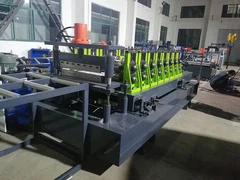
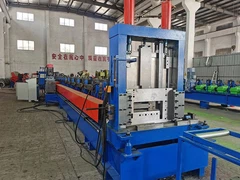
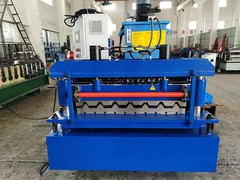
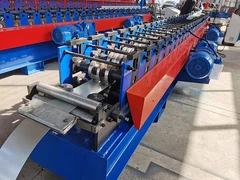
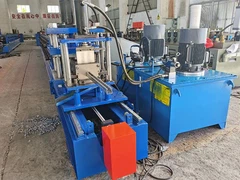
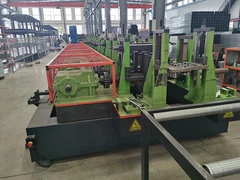
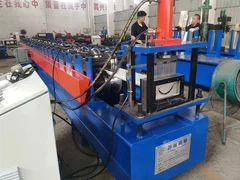
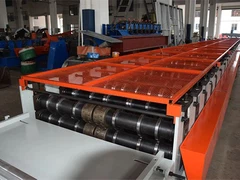
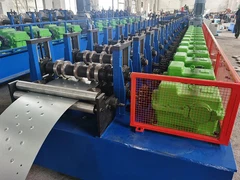
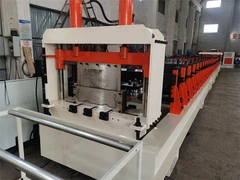

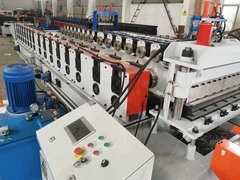
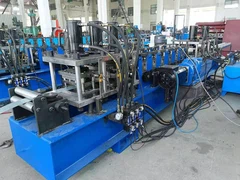

Through long-term practice in serving the metal profile manufacturing industry, the industry has accumulated rich experience in the application of metal roll forming machines. This experience not only involves equipment selection and mastery of process parameters, but also encompasses a systematic understanding of material compatibility, process control, and maintenance management, providing a reference path for improving forming quality and stabilizing production efficiency.
Firstly, regarding equipment selection and roll design, experience shows that a comprehensive evaluation should be conducted based on the cross-sectional complexity of the target profile, the type of material, and the annual production volume. For C/Z-shaped steel and light steel keel with gentle cross-sectional changes and large production batches, machines with moderate roller pass density and stable rigid frames can ensure the stability of continuous operation. For irregular cross-sections or scenarios requiring multiple specification changes, priority should be given to equipment equipped with quick-change roller systems and CNC shaping capabilities to reduce changeover time and debugging difficulty. Roller design requires simulation verification based on the material's mechanical properties, passing through each pass to avoid localized overstretching or wrinkling. This necessitates incorporating material yield strength, elongation, and elastic recovery data during the early process planning stage to ensure a reasonable match between roll gap and reduction.
In the material adaptation and pretreatment stages, practical experience emphasizes the direct impact of strip shape and surface condition on forming quality. Cold-rolled sheets, galvanized sheets, and stainless steel strips should be thoroughly leveled after uncoiling to eliminate coiling stress and wavy bending; otherwise, deviation or cross-sectional distortion may occur during rolling. For incoming materials with significant thickness variations, a closed-loop thickness detection and automatic compensation feeding speed control strategy is recommended to prevent sudden changes in rolling load caused by thickness fluctuations, which could damage the roll surface or reduce dimensional accuracy.
Coordinated parameter control during the forming process is the core of this experience. Feeding speed, roll reduction, and pass spacing should be dynamically matched, especially during material switching or cross-section changes. Step-by-step fine-tuning and a full first-piece inspection are necessary to confirm dimensional and shape compliance before mass production. Multiple practical applications have shown that in progressive forming, the first few passes should guide the strip into the form smoothly with smaller deformation amounts, while subsequent passes gradually increase the pressure. This effectively suppresses springback and residual stress concentration, improving the straightness and end flatness of the finished product.
Regarding equipment maintenance and operation management, experience indicates that regular roller regrinding and surface hardening layer protection are crucial. It is recommended to establish roller wear records and a periodic inspection system to prevent surface scratches or dimensional drift in the profile due to increased roller surface roughness. Lubrication and tightness checks of the transmission system should be included in daily inspections to promptly address gap changes caused by temperature rise or vibration, maintaining long-term stability of forming accuracy.
Furthermore, skills training for on-site operators is indispensable. Skilled operators can quickly identify forming abnormalities (such as side bending, twisting, and wrinkling) and adjust parameters in a timely manner, reducing downtime and scrap rates. Combining data collection and trend analysis can create a predictive maintenance model for equipment status, further improving production line availability.
In summary, the application experience of metal roll forming machines embodies a deep understanding of equipment, materials, processes, and management. Systematically applying these experiences to production practices can not only optimize forming quality and efficiency, but also provide solid support for enterprises to maintain competitiveness in the face of ever-changing market demands.