
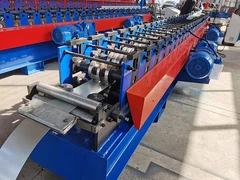
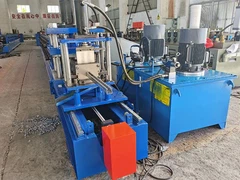
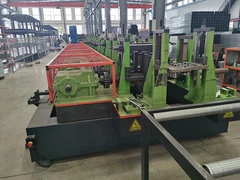
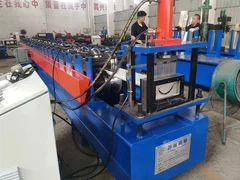

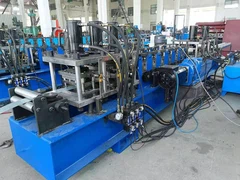

In the modern metal processing industry, cold rolling mills not only bear the technological mission of transforming metal strips into high-precision profiles, but also, due to their continuous and large-scale production characteristics, exhibit distinct systematic, timely, and collaborative features in the logistics links between raw material input and finished product output.This logistics nature permeates the entire production process, directly impacting a company's supply chain efficiency, inventory turnover, and market responsiveness, becoming a crucial dimension for measuring the overall competitiveness of a production line.
The logistics nature of cold rolling mills is primarily reflected in the requirements for the continuity and stability of raw material input. Its core raw materials-metal coils (such as cold-rolled sheets, galvanized sheets, and stainless steel strips)-are typically stored and transported in large quantities and weights, requiring precise warehousing through specialized hoisting equipment or automated storage and retrieval systems. The uncoiling process, as the starting point of logistics, demands a high degree of matching between the coil supply rhythm and the mill's production pace: interruptions in material supply or delays in coil specification switching will lead to production line stagnation; excessive material supply may cause site congestion and risks of coil surface damage. Therefore, an efficient coil scheduling system (such as a material preparation queue ordered according to the production plan and barcode tracking of strip information) becomes a prerequisite for ensuring smooth logistics. Its essence is to achieve the lean logistics goal of "on-demand material supply and zero-wait material loading" through the synchronization of information flow and physical material flow.
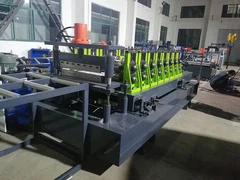
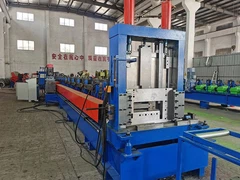
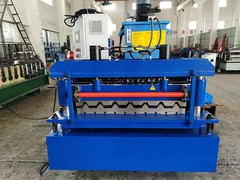
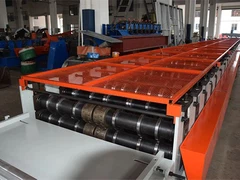
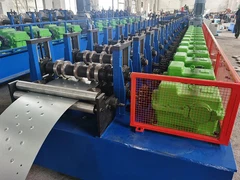
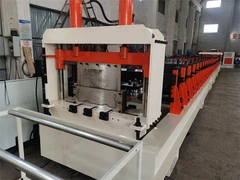
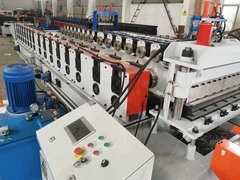
The flow of work-in-process during the production process highlights the dynamic synergy of logistics. The continuous operation mode of the cold rolling forming machine dictates that work-in-process (i.e., long profiles being formed) must pass through forming and cutting processes at a constant speed. Any obstruction in any link will cause the entire line to stop. This characteristic requires that each logistics sub-link-such as the conveying of leveled strip, the fixed-length transfer of formed profiles, and the collection and transfer of cut profiles-must be precisely coupled with the equipment's operating rhythm. For example, the positioning accuracy of the guiding device directly affects the straightness of the strip entering the die. If the material deviation exceeds the threshold, it will cause the profile to bend or the cross-section to distort. Cut profiles need to be transferred to the collection area via synchronous conveyor rollers. If the roller speed does not match the cutting frequency, it can easily cause profile accumulation or collision damage. The realization of this dynamic collaboration relies on the precise control of servo drives and the real-time feedback of sensor networks, essentially representing a deep understanding of the consistency between "logistics flow rate and production process flow rate."
The large-scale and standardized logistics characteristics of finished product output further strengthen the pivotal role of the cold rolling forming machine. The profiles produced by the forming machine are mostly long-length, high-volume products (such as C-shaped steel and light steel keel), requiring centralized collection and temporary storage through dedicated bundling, hoisting, or roller conveyor systems. Its logistics objective is not only "to get it out," but also "to transport it stably and cost-effectively": on the one hand, by cutting to length and classifying and stacking (by specifications, orders, and customers), secondary sorting costs are reduced; on the other hand, by considering the load-bearing and size limitations of transportation vehicles (such as truck bed length and crane lifting radius), the profile stacking method and loading scheme are optimized to improve the single-vehicle loading rate and reduce unit transportation costs. For orders requiring long-distance transportation, temporary protection for the profiles must be considered (such as end sealing to prevent scratches and surface coating for moisture protection). This requires seamless integration between the logistics process and the quality control system to prevent a decline in product quality due to improper logistics operations.
Furthermore, the logistics nature of cold rolling forming machines is also reflected in their linkage with upstream and downstream supply chains. Upstream, it requires coil suppliers to have stable delivery cycles and consistent quality to support continuous production; downstream, finished product logistics needs to be aligned with the construction progress of end users such as building engineering and equipment manufacturing to achieve "delivery according to project milestones." This cross-link linkage drives enterprises to build a full-chain logistics network centered on the forming machine, encompassing "raw materials-work-in-process-finished products." Through digital platforms (such as ERP systems and MES systems), real-time sharing of order, inventory, and transportation information is achieved, thereby reducing supply chain response time and improving overall operational resilience.
The logistics nature of cold rolling forming machines is not an isolated material handling activity, but a systematic engineering project integrating continuity, collaboration, scale, and linkage. By optimizing the pace of raw material input, strengthening the coordination of work-in-process circulation, and standardizing the management of finished product output, it deeply integrates logistics with production processes, quality control, and supply chain needs, becoming a core hub connecting upstream resources and downstream markets in metal processing, and building a solid bridge for enterprises between efficient production and market services.