
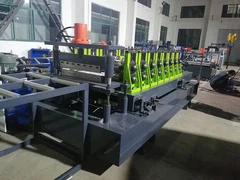
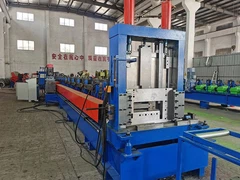
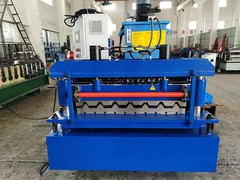
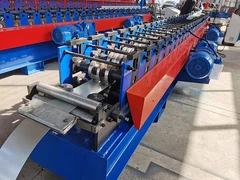
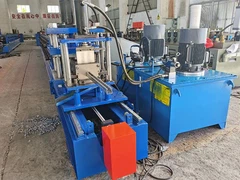
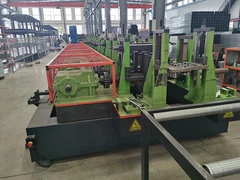
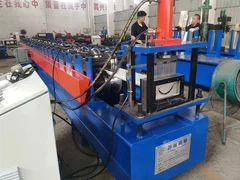
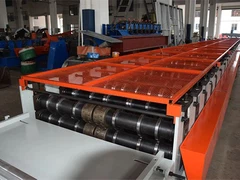
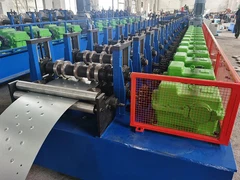
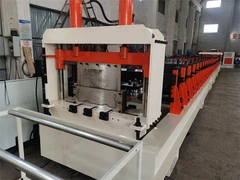

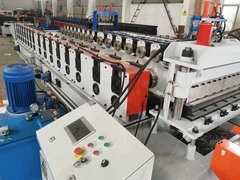
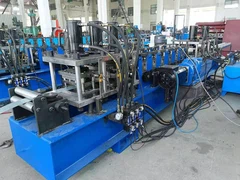

A cold rolling forming machine is a specialized piece of equipment that applies continuous rolling pressure to metal sheets at room temperature, progressively processing them into profiles with specific cross-sections. It integrates multiple technologies, including mechanical transmission, automatic control, and precision mold design. It achieves efficient, continuous, and high-precision profile manufacturing while maintaining the original mechanical properties of the material, thus playing a vital role in steel structure construction, transportation, equipment manufacturing, and metal product processing.
The core principle of a cold rolling forming machine is to utilize multiple sets of sequentially arranged forming rollers to progressively plastically deform the metal strip in successive passes. The sheet metal is drawn out by an uncoiling device, and after passing through a leveling mechanism to eliminate internal stress and shape defects, it enters the forming unit. The forming rollers, according to a preset cross-sectional profile and deformation path, sequentially reduce the roller gap and change the roller curvature, causing the strip metal to gradually bend and extend during continuous feeding, ultimately forming the desired profile shape. The entire process requires no heating, avoiding problems such as oxidation, coarse grains, and dimensional instability that may occur with hot working, thus helping to maintain the material's strength and surface quality.
Structurally, cold rolling forming machines typically consist of an uncoiling and leveling unit, a feeding and guiding device, forming rollers, a length-cutting mechanism, and a discharge collection system. The uncoiling device ensures smooth unwinding of the coil and maintains constant tension; the leveling mechanism eliminates warping and stress in the strip through a multi-roller staggered arrangement, resulting in more uniform subsequent forming; the design of the forming rollers directly determines the profile's precision and forming quality, requiring simulation and experimental optimization based on material thickness, yield strength, and target cross-section; the length-cutting mechanism can precisely cut to a set length to meet the assembly requirements of different projects. Modern models generally incorporate CNC systems and servo drives to achieve precise control of feeding speed, roller gap, and cutting position, significantly improving process flexibility.
The advantages of cold rolling forming machines lie in high forming precision, good surface finish, and high production efficiency. Due to cold processing, oxide scale is less likely to form on the profile surface, reducing subsequent cleaning processes; progressive multi-pass deformation controls springback and stress distribution, ensuring dimensional consistency and shape stability, thereby improving the assembly accuracy and reliability of the finished product. Continuous operation eliminates repeated positioning and handling steps, resulting in high material utilization. It is particularly suitable for the production of long, high-volume profiles, demonstrating outstanding performance in reducing labor and energy costs.
Its application range is very wide, capable of processing various metal materials such as cold-rolled steel sheets, galvanized sheets, stainless steel strips, and aluminum alloy sheets. Formed products include C-shaped steel, Z-shaped steel, U-shaped channels, light steel keels, shelf uprights, decorative profiles, and various structural components. In the construction industry, it provides standardized profiles for light steel structure plants, prefabricated wall and roof systems; in transportation facilities, it is used to manufacture guardrails, track supports, and vehicle frame components; in the logistics and warehousing industry, it provides high-strength load-bearing components for shelves, pallets, and display racks.
With the development of intelligent manufacturing technology, cold rolling forming machines are moving towards higher levels of automation and informatization. Models integrating online detection, data traceability, and remote monitoring functions can monitor forming accuracy and equipment status in real time, provide early warnings of anomalies, reduce downtime risks, and improve the overall efficiency of the production line. As an important bridge connecting metal raw materials and end structural components, cold rolling forming machines, with their unique advantages of room temperature precision forming, efficient continuous operation and wide material compatibility, continue to provide reliable process support for the metal processing industry, and promote the industry to steadily move towards high quality and large scale.